Today students took notes on Lesson 7 vocabulary words.
After 30 minutes, students then worked on finding details to support a text-specific question on TEXT #9 from the BRAIN GAIN unit. One example I gave that might make this assignment more accessible for you is
What details support Arne Duncan's belief that I should go to college?
DON'T FORGET to write down line numbers after you have found a good quotation.
You are ready for the final assessment if you have completed the Analyzing Details chart today.
Showing posts with label Brain Gain. Show all posts
Showing posts with label Brain Gain. Show all posts
Thursday, November 14, 2013

Wednesday, November 13, 2013
Writing your Final Assessment Paragraph: A little help?
Here is a template with sentence frames for writing your final assessment: Final Paragraph Assessment Template
For those of you in first period, you will need to work on your Analyzing Details chart first on Thursday, before you can begin writing on Friday. I hope that you will make good use of your time in first and third while I am at Napa High School tomorrow.
Paragraphs are due on Monday.
For those of you in first period, you will need to work on your Analyzing Details chart first on Thursday, before you can begin writing on Friday. I hope that you will make good use of your time in first and third while I am at Napa High School tomorrow.
Paragraphs are due on Monday.
WEDNESDAY and THURSDAY: Analyzing Details
Choose from the following text-specific questions and write it at the top of your Analyzing Details chart:
-What details does Duncan give to support his assertion that, "Closing the achievement gap and closing the opportunity gap is the civil rights issue of our generation"? What does he mean by achievement gap and opportunity gap?
--Duncan describes "a paradox at the heart of America's efforts to bolster international competitiveness." What is the paradox and what does he argue is the best path for education in the United States?
--At the end of the passage, Duncan states that these "new partnerships must also inspire students to take a bigger and deeper view of their civic obligations..." What does this suggest about how Duncan wants the United States to think about global competitivenss in terms of education?
What details does Duncan use to support the idea that "education is still the key to...reducing poverty?"
What details support why it is so important that the United States have the highest proportion of college graduates by 2020? (AND?OR "What details support how we will reach the goal of having the highest proportion of college graduates by 2020?")
What details support the claim that "education is the most powerful weapon which you can use to change the world?"
Then, find details from the speech that help you to answer that question.
Start working on your commentary by filling in the "what I think" boxes.
Thursday, November 7, 2013
Here is the post that almost made me lose it today. Thanks for your patience, third period.
Choose from the following text-specific questions and write it at the top of your Analyzing Details chart:
-What details does Duncan give to support his assertion that, "Closing the achievement gap and closing the opportunity gap is the civil rights issue of our generation"? What does he mean by achievement gap and opportunity gap?
--Duncan describes "a paradox at the heart of America's efforts to bolster international competitiveness." What is the paradox and what does he argue is the best path for education in the United States?
--At the end of the passage, Duncan states that these "new partnerships must also inspire students to take a bigger and deeper view of their civic obligations..." What does this suggest about how Duncan wants the United States to think about global competitivenss in terms of education?
What details does Duncan use to support the idea that "education is still the key to...reducing poverty?"
What details support why it is so important that the United States have the highest proportion of college graduates by 2020? (AND?OR "What details support how we will reach the goal of having the highest proportion of college graduates by 2020?")
What details support the claim that "education is the most powerful weapon which you can use to change the world?"
My goal is to have you finish the Analyzing Details chart by the middle of class Tuesday, and then begin to write your Assessment paragraph (using the details to support your answer to one of these questions--that answer will be your claim).
That Assessment paragraph will be due at the end of class Wednesday. If you do not finish in class, then it will be homework.
Tuesday, November 5, 2013
Text #9: Arne Duncan
Denice Frohman spoken word poem
Our last text in the Brain Gain unit is a speech given by Secretary of Education Arne Duncan.
What does his speech make you see or feel?
Let's try out this guiding question with the above poem performance.
Our last text in the Brain Gain unit is a speech given by Secretary of Education Arne Duncan.
What does his speech make you see or feel?
Let's try out this guiding question with the above poem performance.
Monday, October 28, 2013
Tuesday: Vocabulary and Malala's speech at the United Nations
I will be at the district office on Tuesday. Here are your two tasks:
1. Take notes on your new set of vocabulary words from Lesson 6. Lesson 6 quizlet
2. Malala
Yousafzai, the Pakistani girl who was shot in the head by the Taliban in 2012
for demanding education for girls, gave a speech at the United Nations on her
16th birthday in July, 2013 where she spoke about the importance of education.
Watch the video below and write a response, attempting to answer the following questions: What words or phrases stand out to me as I listen? What is her attitude about education?
Please turn it in to the substitute when you are finished.
Monday: Eleanor Roosevelt and the Purpose of Education
Today I described the last part of the Brain Gain unit: a written assessment and a class discussion on the last three texts (#7, #8, and #9). *remember that there are copies of these texts in our shared google doc folder.
Then, we read alound Text #7 "Good Citizenship: The Purpose of Education" by Eleanor Roosevelt.
Our guiding question is: What is Eleanor Roosevelt's attitude toward education/learning?
and
Wbat information/ideas are described in detail?
What do the author's words cause me to see or feel?
We highlighted/underlined any strong opinions or CLAIMS in the essay, and circled any keywords that we thought were important or that we didn't know. We also tried writing notes in the margins, putting brackets around multiple sentences that worked together as evidence or example.
Then, we read alound Text #7 "Good Citizenship: The Purpose of Education" by Eleanor Roosevelt.
Our guiding question is: What is Eleanor Roosevelt's attitude toward education/learning?
and
Wbat information/ideas are described in detail?
What do the author's words cause me to see or feel?
We highlighted/underlined any strong opinions or CLAIMS in the essay, and circled any keywords that we thought were important or that we didn't know. We also tried writing notes in the margins, putting brackets around multiple sentences that worked together as evidence or example.
Wednesday, October 23, 2013
Thursday's class: Paragraph review
Today you are going to assess your group's success in writing a paragraph comparing details from two texts.
Use the following rubric to score your group:
1. There is a clear and specific topic sentence.
(How many in your group have one?) _____
2. There are two carefully chosen quotations or paraphrases in the paragraph, one from each text.
(How many in your group do this?)_____
3. Each quotation or paraphrase has a correct citation at the end of the sentence.
(How many in your group do this?) _______
4. There is insightful analysis after EVERY quotation from the text(s).
(How many in your group do this?) _______
5. The writer uses a transition to move from one writer to the next.
(How many in your group have one?) ______
6. There is a concluding sentence which brings the paragraph to a close.
(How many in your group have one?)_______
7. The writer has clearly proofread, so that there are very few grammatical errors.
(How many in your group did this?) ______
What is your group's total score? _________
To earn extra credit today, help EVERYONE in your group earn a "YES" for each of the above questions, then turn your paragraphs into me with the checklist attached.
Use the following rubric to score your group:
1. There is a clear and specific topic sentence.
(How many in your group have one?) _____
2. There are two carefully chosen quotations or paraphrases in the paragraph, one from each text.
(How many in your group do this?)_____
3. Each quotation or paraphrase has a correct citation at the end of the sentence.
(How many in your group do this?) _______
4. There is insightful analysis after EVERY quotation from the text(s).
(How many in your group do this?) _______
5. The writer uses a transition to move from one writer to the next.
(How many in your group have one?) ______
6. There is a concluding sentence which brings the paragraph to a close.
(How many in your group have one?)_______
7. The writer has clearly proofread, so that there are very few grammatical errors.
(How many in your group did this?) ______
What is your group's total score? _________
To earn extra credit today, help EVERYONE in your group earn a "YES" for each of the above questions, then turn your paragraphs into me with the checklist attached.
Tuesday, October 22, 2013
Tuesday's class: Revising your paragraph
along with a format chart you can use for almost any informative/analytical paragraph you will be asked to write in this class: Informative Paragraph Format
I have put all those SENTENCE FRAMES together in one place to help you in a google doc:
Sentence Frames all together
Monday, October 21, 2013
FOR Thursday's class: Introduction to the Culiminating Activity/Final Assessment
In the last part of the Brain Gain unit, you will take part in a two-stage culminating activity:
1. You will analyze and write about one of three related texts (#7, #8, or #9).
AND
2. You will lead a comparative discussion about the three texts.
Tuesday and Wednesday will be devoted to reading the last three texts together, using Guiding Questions to help us share and explore our first impressions.
Here are the links to the three texts if you lose your copies:
Eleanor Roosevelt: text #7 Who was Eleanor Roosevelt? Click here: http://www.biography.com/people/eleanor-roosevelt-9463366

Thomas Jefferson text #8 Who was Thomas Jefferson? Click here: http://www.biography.com/people/thomas-jefferson-9353715

Arne Duncan text #9 Who is Arne Duncan? Click here: http://en.wikipedia.org/wiki/Arne_Duncan

Also, you will need a copy of the Questioning Texts Questioning Texts linkand the Analyzing Texts handoutAnalyzing Details handout.
1. You will analyze and write about one of three related texts (#7, #8, or #9).
AND
2. You will lead a comparative discussion about the three texts.
Tuesday and Wednesday will be devoted to reading the last three texts together, using Guiding Questions to help us share and explore our first impressions.
Here are the links to the three texts if you lose your copies:
Eleanor Roosevelt: text #7 Who was Eleanor Roosevelt? Click here: http://www.biography.com/people/eleanor-roosevelt-9463366

Thomas Jefferson text #8 Who was Thomas Jefferson? Click here: http://www.biography.com/people/thomas-jefferson-9353715

Arne Duncan text #9 Who is Arne Duncan? Click here: http://en.wikipedia.org/wiki/Arne_Duncan

Also, you will need a copy of the Questioning Texts Questioning Texts linkand the Analyzing Texts handoutAnalyzing Details handout.
Monday: Finishing your Paragraphs
Today we will work on finishing your paragraphs comparing two texts (#5) and (#6).
Be sure that you are using the frames from Thursday's class (posted below).
Also, here are some more to help you introduce your commentary after you have cited a direct quotation or a paraphrase from the text(s). Choose from this list:
What Powell (or Montessori) is saying here is that _____________________________________.
What this means is that ___________________________________________________________.
This is important because _________________________________________________________.
This shows the emphasis on structure (or freedom) because ______________________________.
ONE LAST NOTE: Proofread your paragraph for punctuation, spelling and grammar errors before you turn it in! Make sure you have correct citation format for each detail/example from the two writers.
Be sure that you are using the frames from Thursday's class (posted below).
Also, here are some more to help you introduce your commentary after you have cited a direct quotation or a paraphrase from the text(s). Choose from this list:
What Powell (or Montessori) is saying here is that _____________________________________.
What this means is that ___________________________________________________________.
This is important because _________________________________________________________.
This shows the emphasis on structure (or freedom) because ______________________________.
ONE LAST NOTE: Proofread your paragraph for punctuation, spelling and grammar errors before you turn it in! Make sure you have correct citation format for each detail/example from the two writers.
Thursday, October 17, 2013
Thursday's class: Sentence Frames to help you with your paragraphs
Today we started with Intervention or Enrichment for Vocabulary Lesson 4.
Then, we continued work on "Analyzing Across Texts." Students decided on a comparative question to use to focus their paragraph, then began filling out the chart, looking for key details that either show a difference or a similarity between the two writers (Powell and Montessori).
Once students were ready to write, I gave them a few frames for support:
1. BEGINNING YOUR PARAGRAPH:
The difference (or similarity) between Powell and Montessori is_____________________________.
OR
The examples Powell and Montessori use demonstrate one big difference in their perspective on childhood development: ________________________________________________________________________.
2. Using details. You have a choice here.
You can Paraphrase:
According to Montessori, adults push children into behaviors without paying any attention to their desires, interests, or capabilities (30-31).
OR
Use a Direct Quotation:
According to Montessori, "we try to force them to follow us without regard to their special needs"(30-31).
Don't forget to include analysis (another word for this is commentary) about the details you have chosen.
3. Transitioning between writers/ texts:
Powell is clearly saying here _____________________________. In contrast, Montessori is _________________________________.
Paragraphs are due at the end of the period on Friday.
Don't forget to bring your OUTSIDE READING books to class tomorrow, along with your 4 night journal sheet!
Then, we continued work on "Analyzing Across Texts." Students decided on a comparative question to use to focus their paragraph, then began filling out the chart, looking for key details that either show a difference or a similarity between the two writers (Powell and Montessori).
Once students were ready to write, I gave them a few frames for support:
1. BEGINNING YOUR PARAGRAPH:
The difference (or similarity) between Powell and Montessori is_____________________________.
OR
The examples Powell and Montessori use demonstrate one big difference in their perspective on childhood development: ________________________________________________________________________.
2. Using details. You have a choice here.
You can Paraphrase:
According to Montessori, adults push children into behaviors without paying any attention to their desires, interests, or capabilities (30-31).
OR
Use a Direct Quotation:
According to Montessori, "we try to force them to follow us without regard to their special needs"(30-31).
Don't forget to include analysis (another word for this is commentary) about the details you have chosen.
3. Transitioning between writers/ texts:
Powell is clearly saying here _____________________________. In contrast, Montessori is _________________________________.
Paragraphs are due at the end of the period on Friday.
Don't forget to bring your OUTSIDE READING books to class tomorrow, along with your 4 night journal sheet!
Wednesday, October 16, 2013
Tuesday and Wednesday's class
Yesterday I was gone at the District Office. You were supposed to use the first half of class to take notes on Vocabulary Lesson 5. Flashcards have been posted on my quizlet page (to the right of the posts).


The second half was used to start your next task, which is to compare or contrast the last two Odell texts we have read together (Powell v.s Montessori). The link to the handout is here: Analyzing Details Across Texts
Today we reviewed Lesson 5 and vocabulary test 4.
We also reviewed student answers to the front side of the Analyzing Details handout. You should be ready to write your paragraph about the two texts tomorrow after the Intervention of Lesson 4 folks.

The second half was used to start your next task, which is to compare or contrast the last two Odell texts we have read together (Powell v.s Montessori). The link to the handout is here: Analyzing Details Across Texts
Today we reviewed Lesson 5 and vocabulary test 4.
We also reviewed student answers to the front side of the Analyzing Details handout. You should be ready to write your paragraph about the two texts tomorrow after the Intervention of Lesson 4 folks.
Monday, October 14, 2013
Monday's class: Montessori's perspective
Today we completed an Analyzing Details chart for Text #6. You were supposed to do this in partners. Everyone tried to get to that "connecting sentence" at the bottom and we voted for the best one at the end of class.
Tomorrow you will begin comparing Text #5 and Text #6, ultimately writing a paragraph about a similarity or difference that you notice between them. Here is a link to the assignment: Powell vs. Montessori
Lesson #5 words are also introduced tomorrow!
Thursday, October 10, 2013
Thursday's class: Text #6
Today we read a new text by Dr. Maria Montessori about childhood education. We filled out a Questioning Texts handout with all the text info ("Dr. Maria Montessor's Own Handbook" by Dr. Maria Montessori, Publisher Frederick A. Stokes Co, 1914) and talked about our expectations for this text, based on that information.
Then we read it aloud, looking for places in the text to mark based on these guiding questions:
What is the author's attitude toward the topic? How does the author's language show her perspective?
In the last remaining minutes of class, students worked in partners to compose a TEXT-SPECIFIC question, using their highlighted marks.
Vocabulary Lesson 4 test tomorrow!
Then we read it aloud, looking for places in the text to mark based on these guiding questions:
What is the author's attitude toward the topic? How does the author's language show her perspective?
In the last remaining minutes of class, students worked in partners to compose a TEXT-SPECIFIC question, using their highlighted marks.
Vocabulary Lesson 4 test tomorrow!
Wednesday, October 9, 2013
Wednesday's class
SIGN UP FOR REMIND 101...will take the place of edmodo for reminders.
What details does Powell provide in paragraph 3 that describe how the military places young men "in an environment of structure?"
As you reread Paragraph 3, highlight and mark details in this paragraph that might help you answer this question.
Write those details in the "Selecting Details" part of the chart. Share them with your partner.
In partners, discuss what those details mean and then fill in "What I think about..." for each detail. (This is your COMMENTARY).
Then compose a sentence that links the commentary together and ANSWERS the text-specific question.
We will vote on which group did the best job here.
ROUND TWO: with your partner compose your own TEXT-SPECIFIC QUESTION and fill out the chart together. The class will share and vote on these as well.
What details does Powell provide in paragraph 3 that describe how the military places young men "in an environment of structure?"
As you reread Paragraph 3, highlight and mark details in this paragraph that might help you answer this question.
Write those details in the "Selecting Details" part of the chart. Share them with your partner.
In partners, discuss what those details mean and then fill in "What I think about..." for each detail. (This is your COMMENTARY).
Then compose a sentence that links the commentary together and ANSWERS the text-specific question.
We will vote on which group did the best job here.
ROUND TWO: with your partner compose your own TEXT-SPECIFIC QUESTION and fill out the chart together. The class will share and vote on these as well.
Tuesday, October 8, 2013
Text #5: Text-specific Questions
Today we are going to practice using text-specific questions to further understand a text.
FIRST, it is essential that you reread Text #5, highlighting and marking details that relate to your GUIDING QUESTIONS (the ones you already have written in your Questioning Texts handout).
SECOND, take a detail that you have highlighted and put it in a TEXT-SPECIFIC QUESTION that forces you to focus your analysis and deepen your understanding.
THIRDLY, here is the question for us to practice together that I would like you to add to the top of your Analyzing Details chart:
What details does Powell provide in paragraph 3 that describe how the military places young men "in an environment of structure?"
As you reread Paragraph 3, highlight and mark details in this paragraph that might help you answer this question.
Write those details in the "Selecting Details" part of the chart. Share them with your partner.
In partners, discuss what those details mean and then fill in "What I think about..." for each detail. (This is your COMMENTARY).
Then compose a sentence that links the commentary together and ANSWERS the text-specific question.
We will vote on which group did the best job here.
ROUND TWO: with your partner compose your own TEXT-SPECIFIC QUESTION and fill out the chart together. The class will share and vote on these as well.
FIRST, it is essential that you reread Text #5, highlighting and marking details that relate to your GUIDING QUESTIONS (the ones you already have written in your Questioning Texts handout).
SECOND, take a detail that you have highlighted and put it in a TEXT-SPECIFIC QUESTION that forces you to focus your analysis and deepen your understanding.
THIRDLY, here is the question for us to practice together that I would like you to add to the top of your Analyzing Details chart:
What details does Powell provide in paragraph 3 that describe how the military places young men "in an environment of structure?"
As you reread Paragraph 3, highlight and mark details in this paragraph that might help you answer this question.
Write those details in the "Selecting Details" part of the chart. Share them with your partner.
In partners, discuss what those details mean and then fill in "What I think about..." for each detail. (This is your COMMENTARY).
Then compose a sentence that links the commentary together and ANSWERS the text-specific question.
We will vote on which group did the best job here.
ROUND TWO: with your partner compose your own TEXT-SPECIFIC QUESTION and fill out the chart together. The class will share and vote on these as well.
Wednesday, October 2, 2013
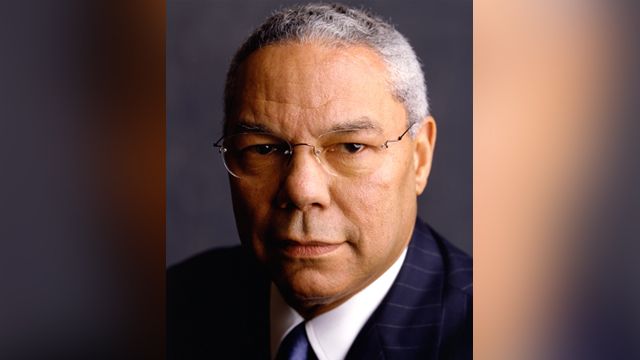
Text #5: Kids Need Structure by Colin Powell, 2012
FOR CLASS on THURSDAY.
This text is another speech, this time by our former U.S. Secretary of State Colin Powell.
Kids Need Structure by Colin Powell: link to video
We are going to focus only on the first 8 minutes (our text officially ends at 8minutes and 10 seconds).
You are going to be filling out a QUESTIONING TEXTS WORKSHEET. Questioning Texts Worksheet
Here are some sample GUIDING QUESTIONS for your first reading:
This text is another speech, this time by our former U.S. Secretary of State Colin Powell.
Kids Need Structure by Colin Powell: link to video
We are going to focus only on the first 8 minutes (our text officially ends at 8minutes and 10 seconds).
You are going to be filling out a QUESTIONING TEXTS WORKSHEET. Questioning Texts Worksheet
Here are some sample GUIDING QUESTIONS for your first reading:
- What do the author's words cause me to see or feel?
- What ideas stand out to me as I read?
- How do the ideas relate to what I already know?
After viewing, look for details related to those questions and record them in the "questioning texts" handout.
2nd read: Work with your partner to come up with TEXT-SPECIFIC QUESTIONS to put in the final row of the Questioning Texts Worksheet.
Share with the class and turn them in to Mrs. LaMonte.
Sunday, September 29, 2013
BRAIN GAIN homework for Monday, September 30!
View this website tonight: http://www.pbs.org/kcet/publicschool/
and answer the following questions on this google form:
https://docs.google.com/forms/d/15oaoUVKIjJ-QX1g-Uo8EKGw3T2htwhNYylS0BmaCwqU/viewform
Here is the link to your responses: RESPONSES TO FORM
and answer the following questions on this google form:
https://docs.google.com/forms/d/15oaoUVKIjJ-QX1g-Uo8EKGw3T2htwhNYylS0BmaCwqU/viewform
Here is the link to your responses: RESPONSES TO FORM
Brain Gain: Activity 4 Ken Robinson's "Changing Paradigms"
Activity 4: Attending to Details in Multi-Media
In this activity, you will look closely for details in a multi-media text and write a few sentences explaining something you have learned.
After you have watched the video the first time, think about these GUIDING QUESTIONS:
What ideas stand out to me as I view this video?
What is the author saying about the topic?
Second Viewing: Use this Text-Specific GUIDING QUESTION:
What details does Robinson use to support his belief that schools are "...trying to meet the future by doing what they did in the past and on the way they are alienating millions of children who don't see any purpose in going to school..."?
Using a two-column notes (or "T" notes) format:
---record the key details from the passage,
---highlight key words
--- explain in the 2nd column why these details are important
In partners, discuss the details you selected and share why you thought they were important.
THEN, write a few sentences explaining something you learned from the video, referring to key details that have led to your understanding. Write it neatly....it's going on the ladybug!!!
In this activity, you will look closely for details in a multi-media text and write a few sentences explaining something you have learned.
What ideas stand out to me as I view this video?
What is the author saying about the topic?
Second Viewing: Use this Text-Specific GUIDING QUESTION:
What details does Robinson use to support his belief that schools are "...trying to meet the future by doing what they did in the past and on the way they are alienating millions of children who don't see any purpose in going to school..."?
Using a two-column notes (or "T" notes) format:
---record the key details from the passage,
---highlight key words
--- explain in the 2nd column why these details are important
In partners, discuss the details you selected and share why you thought they were important.
THEN, write a few sentences explaining something you learned from the video, referring to key details that have led to your understanding. Write it neatly....it's going on the ladybug!!!
Subscribe to:
Posts (Atom)