Showing posts with label Making Evidence Based Claims. Show all posts

Thursday, May 29, 2014

Thursday, May 29

Annotating a Source

Target: to find a good source of information on your area of investigation (one that helps you answer your question) that you can practice READING CLOSELY in order to come to a claim.

Begin today by finding a good source using the Napa Country Databases or the google search engine that will help you answer your inquiry question. If you found one yesterday that you emailed to yourself from the databases, you may use that one!

If you haven't already, fill out this "Got Credibility?" form to ensure that you have found a credible source: http://goo.gl/hwglaV

 Copy and paste the source you have found into a copy of this document for you to record your annotations and work towards making a claim.  (Be sure to put it in your research folder.)

Monday, May 5, 2014

TUESDAY's Class: Gathering evidence to support your claim

Today we will breaking our thesis statement into distinct claims or points, in order to narrow our search for evidence to support our/your thesis.

By the end of the period, you should have at least two pieces of evidence for each point/claim.

See my model here: http://goo.gl/BH6iNi

Wednesday, April 23, 2014

Wednesday: Group claims

Learning Target: In your table groups, today you will be making a claim about a theme using connections between the characters in Act Three in Romeo and Juliet.


1. (5 min) After we are finished watching Act Three, get into your groups and discuss the patterns of behavior you notice among all the main characters in the play.  You can use the back side of the Making Claims chart.

2. (5 min) As a class, we will list those connections on the board.

3. (10 min) As a group, take that connection and use it to form an intelligent statement about what you learn about that topic from reading/watching Act Three.  Line up the evidence underneath.

For example,  in Act One, you might make a theme statement (claim) that reads like this:

Connection:  family loyalty/war

Theme:  Sometimes the love for "family" can drive us to hate others and create chaos and violence out of peace. 

    Evidence:  The servants who hate each other only because they are members of the opposite family.
    Evidence: Romeo says about the aftermath of the fight scene, "Here's much to do with hate, but more with love."
    Evidence:  Tybalt wants to fight Romeo at the party in order to establish Capulet honor....Romeo's presence there is an insult and should not be tolerated, even though Romeo brings only love with him.


Monday, April 21, 2014

Monday: Claims in Act 3

Learning Target: Today you will be continuing your work reading your scene from Act 3 closely and forming a claim, based on a few key details.


About half way through the period, we will be presenting our claims to each other in a shared google doc and then using that conversation to make a claim about a THEME in the Act.

Link to shared google doc for posting your claim:

Period 1 : http://goo.gl/sJaC4n

Period 3: http://goo.gl/aZxvD7

Period 5: http://goo.gl/Uvt6tf

Here is the form we will use to make a CLASS CLAIM together about the theme in Act 3: http://goo.gl/QpUuFf

Monday, April 14, 2014

Learning Target:  Speaking and Listening


Collaborate and Discuss
Data: Socratic Seminar / Student-Centered Discussion

Skill
A
P
AP
NP
1) Prepare for discussion and follow guidelines for the conversation


2) Present ideas and claims clearly, using details to support my claims


3) Pose good questions that are centered on the text


4) Make thoughtful connections between my ideas and others


Today, you will be PRESENTING your claim from yesterday to a small group (20 min) and filling out this self-evaluation**. (5-10 min). 

Guidelines:  

  1. Meet with the 3 other people assigned your number.  
  2. Assign the oldest member the position of TIMER.  He/she may use his phone as a stopwatch.
  3. PRESENTER: Share your claim and explain the details you found to support your claim. You have 5 minutes to share and answer questions.
  4. LISTENER:  Ask questions AND/ OR tell the group how this claim relates or connects to your claim.  What patterns do you notice in the text?
  5. Fill out the self-evaluation hyperlinked above.


 **Make sure to make a copy of the self-evaluation and put it in  your English folder, of course.


Last 15 minutes: AUDIO LINK

 Listen to Act 3, scene 1 and submit your answer to one of these questions as your "exit ticket:

What do the author's words cause me to see or feel?

What words or phrases are powerful and unique?


Tuesday, April 8, 2014

Romeo and Juliet: Claims about the Balcony Scene

Today we will watch some of the balcony scene, Act Two, scene ii in order to help you visualize the choices one director, Franco Zefferelli, made about staging that scene.

Then, we will review your lines from yesterday and you will submit claims that answer the following questions to another shared document.

What does Romeo want?
What does Juliet want?

First period: http://goo.gl/zEj8Kr

Third period: http://goo.gl/WWQmJl

5th period: http://goo.gl/YX4n87


Friday, April 4, 2014

FRIDAY: My heart never loved til this night!

Act One, Scene Five (I.v.)

Today we will closely consider the first lines Romeo and Juliet speak to each other.

After watching the Zefferelli version, we will try to defend these two claims with evidence from this scene (using the Making EBC's handout):


Claim: Romeo uses figurative language to get Juliet’s love.

Claim: Romeo and Juliet are doomed lovers.

Tuesday, March 18, 2014

Wednesday's class: Forming Claims and Scenes 2-4

Making connections/forming claims:


15-20 minutes: Today we will move from connections to full-fledged claims in order to answer the questions from yesterday.  

I will model and then you will do it yourself on the handout from yesterday. Here is the model from each period:  


Friday, March 14, 2014

FINISHING APOLOGY PARAGRAPHS!!!!

On Friday we switched gears from Romeo and Juliet, back to "Apology" so that students could use class time to check in with me and complete their final paragraphs.  If you were absent today, please be sure to check in with me tomorrow about attending RTI next week.

Here is the rubric I will be using to assess your final paragraphs: EBC RUBRIC


Friday, March 7, 2014

Friday: FINAL ASSESSMENT ON "APOLOGY"

Today you will write your final assessment of the skills we have been practicing the entire unit.

HERE are the ELO's for this assignment we reviewed on Monday:
3) Write interior paragraphs that use claims, supported by evidence and commentary.


1) Paraphrase the author’s words in order to support my claim.


2) Introduce, use, and cite evidence properly that support my claim


3) Present a reasoned commentary of the details   


Here is a model of what your final writing should look like:  http://odelleducation.com/wp-content/uploads/2012/08/Written-EBC-Model-Plato.pdf

You can choose any claim you like; it can be one you make on your own, or it be one that I have given you this week (see Thursday's handout).  The goal is to see if it can be broken into TWO PARTS, like the model, so you have two paragraphs of support to write.

Each interior paragraph should have:

A CLAIM

EVIDENCE (from the last half of the speech)

COMMENTARY that explains what the details/evidence means to you and how it SHOWS the claim you are making.

If you do not finish today, you have a few options: 

Complete the one page writing over the weekend, OR come to RTI to finish with my help next week.

It is due by FRIDAY, May 14.

Tuesday, March 4, 2014

Wednesday's class: The Slower Runner, Death

Plato's "Apology": Paragraphs 18-23

On Wednesday you will be finishing Plato's version of Socrates' defense.  While you read/listen, highlight and underline important details in the text. 

Then you will fill out a forming evidence-based claims handout in order to form conclusions about Socrates' attitude towards dying, the penality he must face for his "crimes" against the citizens of Athens.

The work you do today is very important and will factor into your final assessment of this EVIDENCE-BASED Claims unit.  You will need this work for Friday, when you will be writing two paragraphs in class.


Some of your claims from today:

Socrates thinks the death sentence isn't fair.

Socrates thinks that death could be bad or good depending on the person.

Socrates thinks death is great because he want to die; it will set him free.

Socrates thinks it is better to die than live so he won't disturb anyone.

Socrates thinks death is a good thing.

Socrates thinks death could possibly be a "splendid journey."

Socrates thinks death is what has been placed on his path and if so, he is ready to die and see what happens next.

Socrates thinks death is the solution so he won't have anymore problems.

Socrates thinks death could be a good place to go.

Socrates thinks death isn't a bad thing if you have not done anything bad.

Socrates thinks death is not necessarily a bad thing; it can be better than living on earth.  Death isn't always a punishment as much as a reward for some people.

Socrates thinks death is a good thing because it changes your way of thinking and elminates your problems.

Socrates thinks death is a good thing because then he doesn't have to listen to people complain to him that what he's teaching them isn't ok.

Socrates thinks death is good for him because of all the charges he will be released from and what Socrates can do, such as obsrve who is wise and who thinks he is wise but isn't in the underword.


Tuesday: Making claims


"Apology": Paragraphs 10-17

Today we finished making claims in partners on evidence in paragraphs 10-17.  See MODEL

Then, your exit ticket is/was breaking that claim into two parts.  See MODEL

Here is an amazing video I found of a nine-year-old Socrates.  We will watch it together on FRIDAY:


LINK to story about this kid.

Sunday, March 2, 2014

A return to Plato's "Apology": Paragraphs 10-17

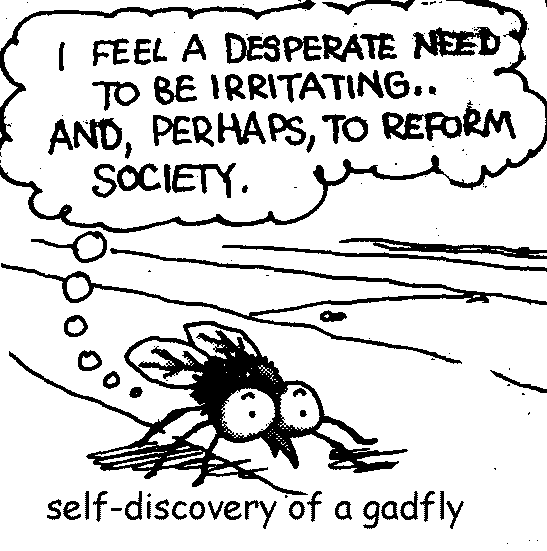
"Someone like me...a gadfly"


On Monday we will pick up "Apology" again and read paragraphs 10-17, first together and then in partners, in order to make a claim about Socrates that can be supported with details from the reading.

We will be using this tool today to help us write our claims down: http://goo.gl/EbnWU1

Here is where I will post the claims you vote for as the best from today's class:


Monday, February 24, 2014

Monday: Making claims about the "Old Age" section in The House of the Scorpion

Finding details that connect....


Today we will work on finishing this chart: FORMING EBCs

I mentioned that a good way to do this is to think of a THEME or big idea that you see after reading the text closely, ( THEMES HOS) and then find other details in the chapter that are related to that theme.

FORMING A CLAIM...


This is difficult, because it requires you to look even closer at those key details and figure out, just like a detective, what meaning is hiding behind them.

Remember my sample claim from the "The Thing on the Bed" chapter?

Even though Tom wants to hurt Matt, showing Matt the truth does not destroy him, but instead makes him stronger. 

Here are samples of claims from class today:


Monday, February 3, 2014

Monday's class: Making Evidence Based Claims

House of the Scorpion--check in

We started by discussing the quiz from Friday.  We also looked at the themes at work in HOS and I awarded Dojo Points to students who were able to recall parts of the story that related to those themes.  The reading assignment is to read to page 101 by Friday.

Apology:  Making Evidence Based Claims


We reviewed the group answers from Thursday.  Then, I supplied you with a claim "Socrates is arrogant."  We decided that the text does not support that claim, so we revised it to say the opposite!

Tomorrow the class will evaluate the evidence presented to each group in a Gallery Walk.

REMINDER:  Tuesday and Wednesday we are on the CAHSEE schedule.